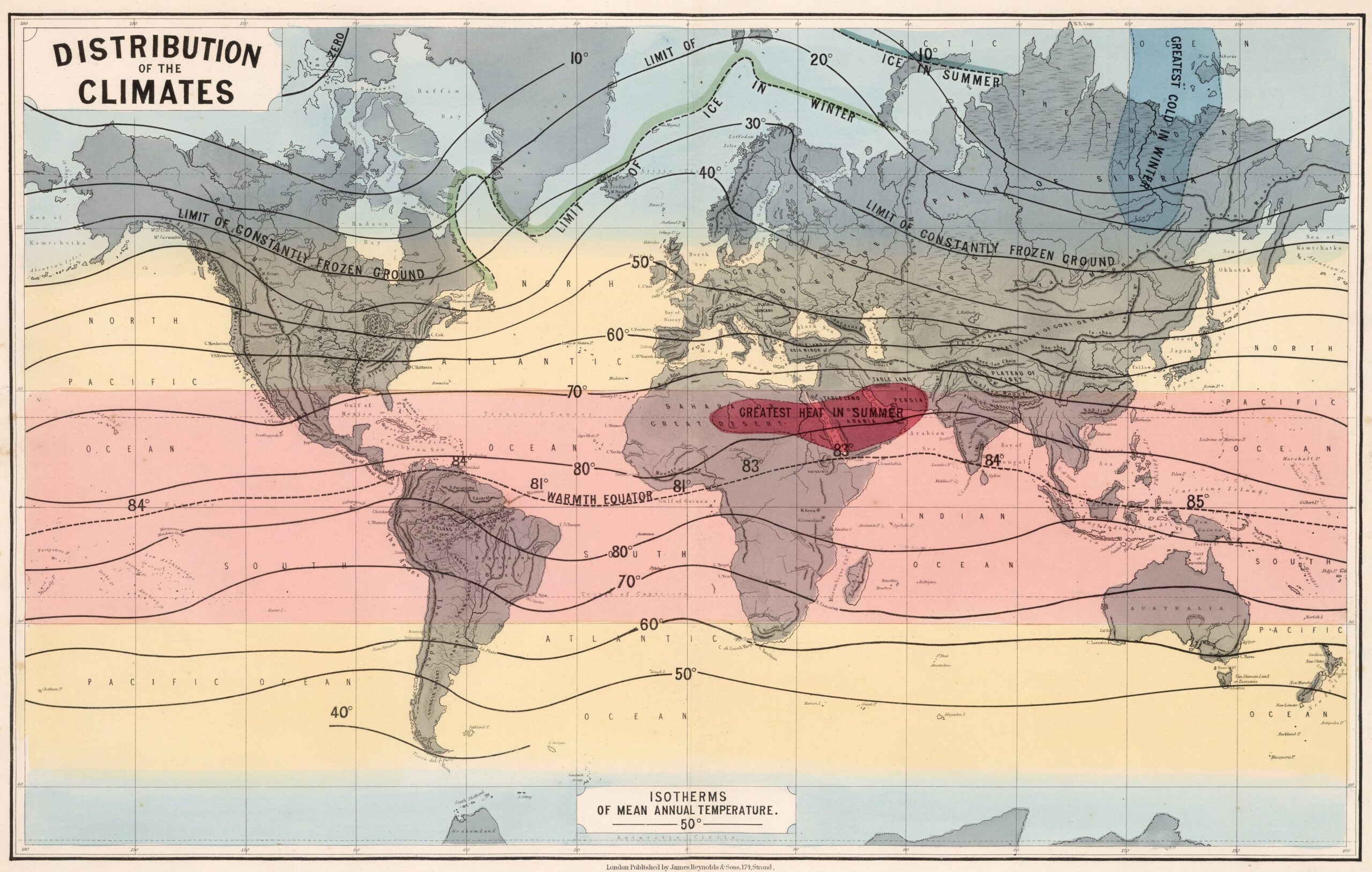
This map, published in 1862 by James Reynolds, shows the distribution of climates around the world, at least according to the understanding of climate that existed in the mid-20th century.
The map is crossed by a series of isotherms, which determine which points on the globe have the same average temperature. Temperatures are expressed in Fahrenheit. For reference, 80 °F is equivalent to 26.7 °C and 20 °F is equivalent to -6.7 °C. In addition, the map includes coloured bands representing different latitudes: red for equatorial, yellow for intermediate, and blue for polar.
There is also a green line at the top, representing the extent of the Arctic ice shelf in winter, and a blue line showing the retreat of the shelf in summer. In addition, the area with the highest summer temperatures is marked in the eastern Sahara and the Arabian Peninsula.
Sources

 Español
  English (UK)