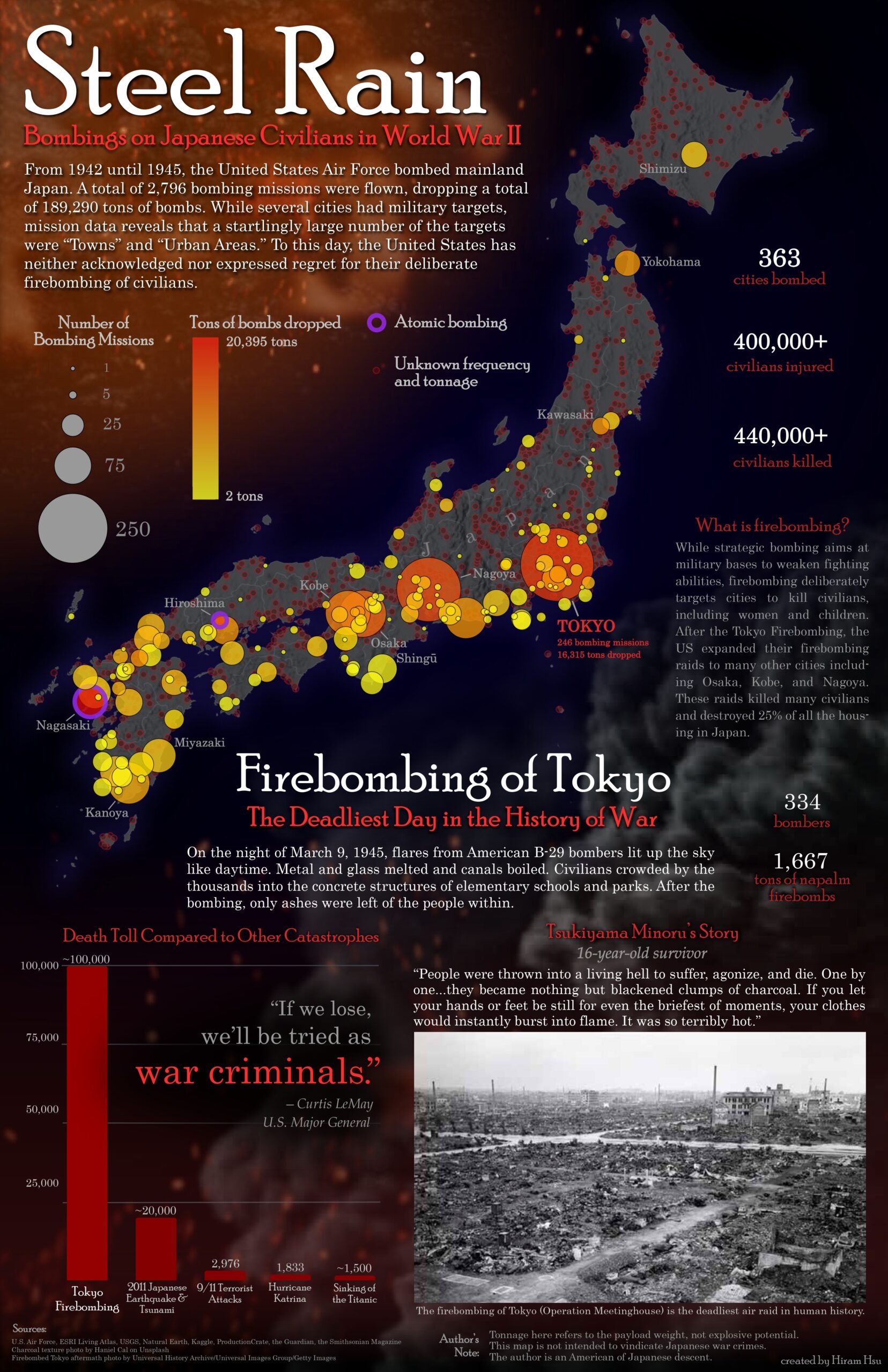
This infographic, created by Hiram Hsu, an American cartographer of Japanese descent, was published in 2026. It won the category Emerging Professional / Creative Map of the annual awards of the GIS Certification Institute (GISCI).
The map focuses on US bombing raids on Japan between 1942 and 1945. Taking into account the 2,796 missions, 189,290 tons of bombs were dropped on 363 Japanese cities. Each city that was attacked is shown as a circle: the size reflects the number of missions, while the colours focus on the tonnage dropped. The atomic bombs on Hiroshima and Nagasaki have a purple circle added to make them easily identifiable.
The title borrows a Japanese expression popularised in the Pacific War, tetsu no ame (rain of steel). This was how the Okinawans described the 1945 Battle of Okinawa, referring to the intensity of US fire. Hsu, the author, transposes this term to the entire bombing campaign over Japan, in an attempt to give weight to the impact of US bombing on the Japanese civilian population.
In the central part, Hsu also focuses on Operation Meetinghouse over Tokyo on the night of 9-10 March 1945, which has gone down in history as the most deadly bombing in a single night. In just a few hours, 334 US B-29 bombers dropped 1667 incendiary tons of napalm, killing more than 100,000 people.
The quotes accompanying the infographic further the author's intention to provide a different perspective from the official one in the United States. In addition to one from Tsukiyama Minoru, a survivor of the Tokyo bombing, he also incorporates one from General Curtis LeMay, in which he states that if the US had been the loser, they would have been tried for war crimes.
As Hsu rightly points out at the bottom, the US never officially acknowledged or expressed remorse for the bombing of civilians in Japan during World War II. He also makes it clear that he does not seek to justify Japanese war crimes, but rather to highlight those committed against the Japanese civilian population.
Sources

 Español
  English (UK)