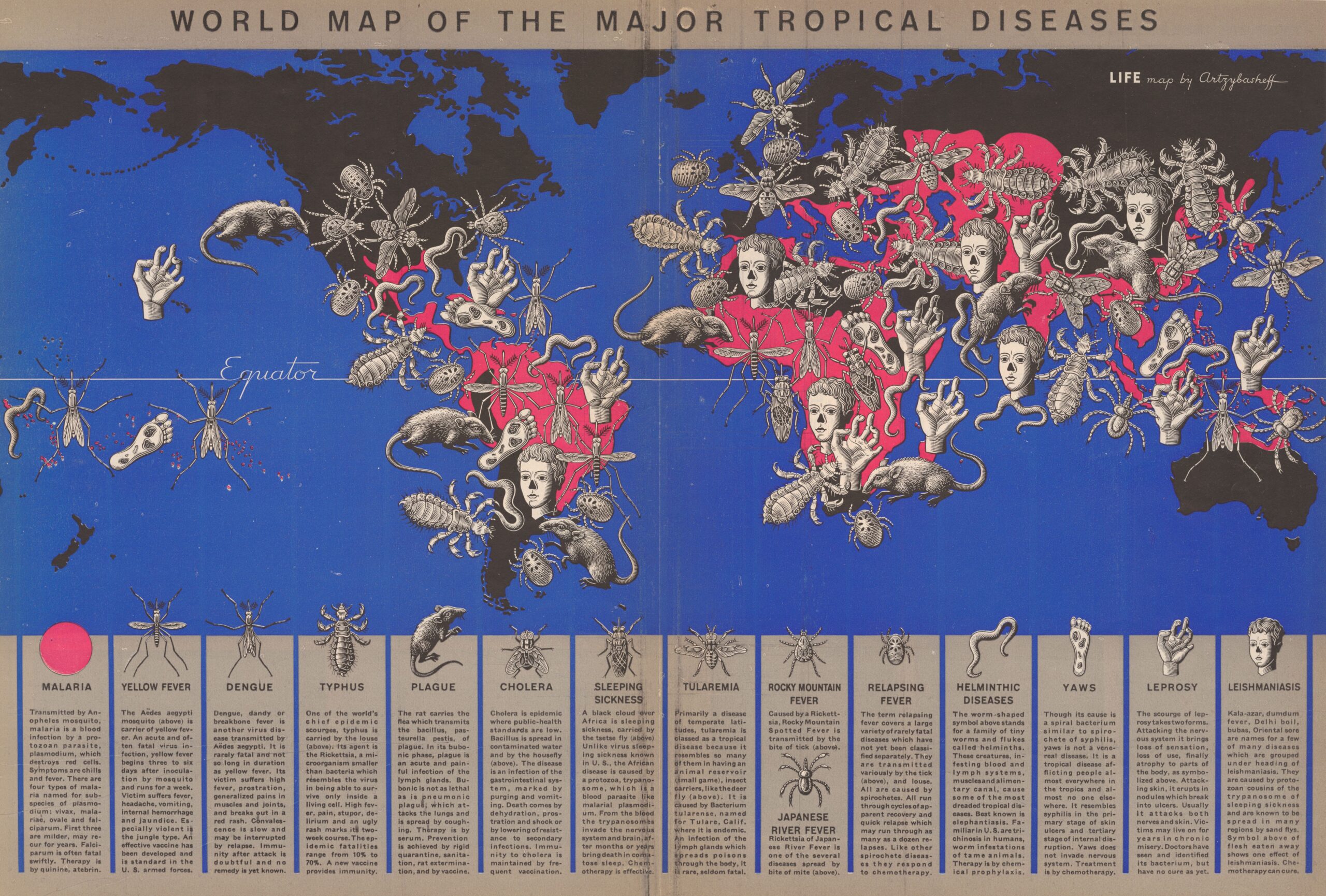
This illustration was created by Boris Artzybasheff, an American artist of Ukrainian origin, in 1944. It was published as part of an article in Life magazine on tropical diseases around the world.
The Life article and this particular map sought to raise awareness about the serious problem of various tropical diseases around the world and how they affected virtually the entire globe.
The colour red is used for the quintessential tropical disease, malaria, but the illustration is also accompanied by fourteen other images representing other diseases in a sensationalist way in order to capture attention:
- Yellow feverrepresented with a mosquito.
- Dengerepresented with a mosquito.
- Typhusrepresented with a flea.
- Plaguerepresented by a rat.
- Cholerarepresented by a common fly.
- Sleeping sicknessrepresented with the tsetse fly.
- Tularemiarepresented by a horsefly.
- Rocky Mountain Feverrepresented by a tick.
- Japanese spotted feverrepresented by a tick.
- Relapsing feverrepresented by a tick.
- Helminthiasisrepresented by a worm.
- Pianrepresented with a foot with nodules.
- Leprosydepicted with an affected hand.
- Leishmaniasisdepicted with a face without a nose.
There are various reasons for using different images. In the vast majority of cases, the most common vectors for each disease (arachnids, insects or rats) are used. In some cases, reference is made to the parasite causing the disease (as in the case of helminthiasis), and in others, the illustration focuses on the effects (as in the cases of leprosy or leishmaniasis).
Sources


 Español
  English (UK)