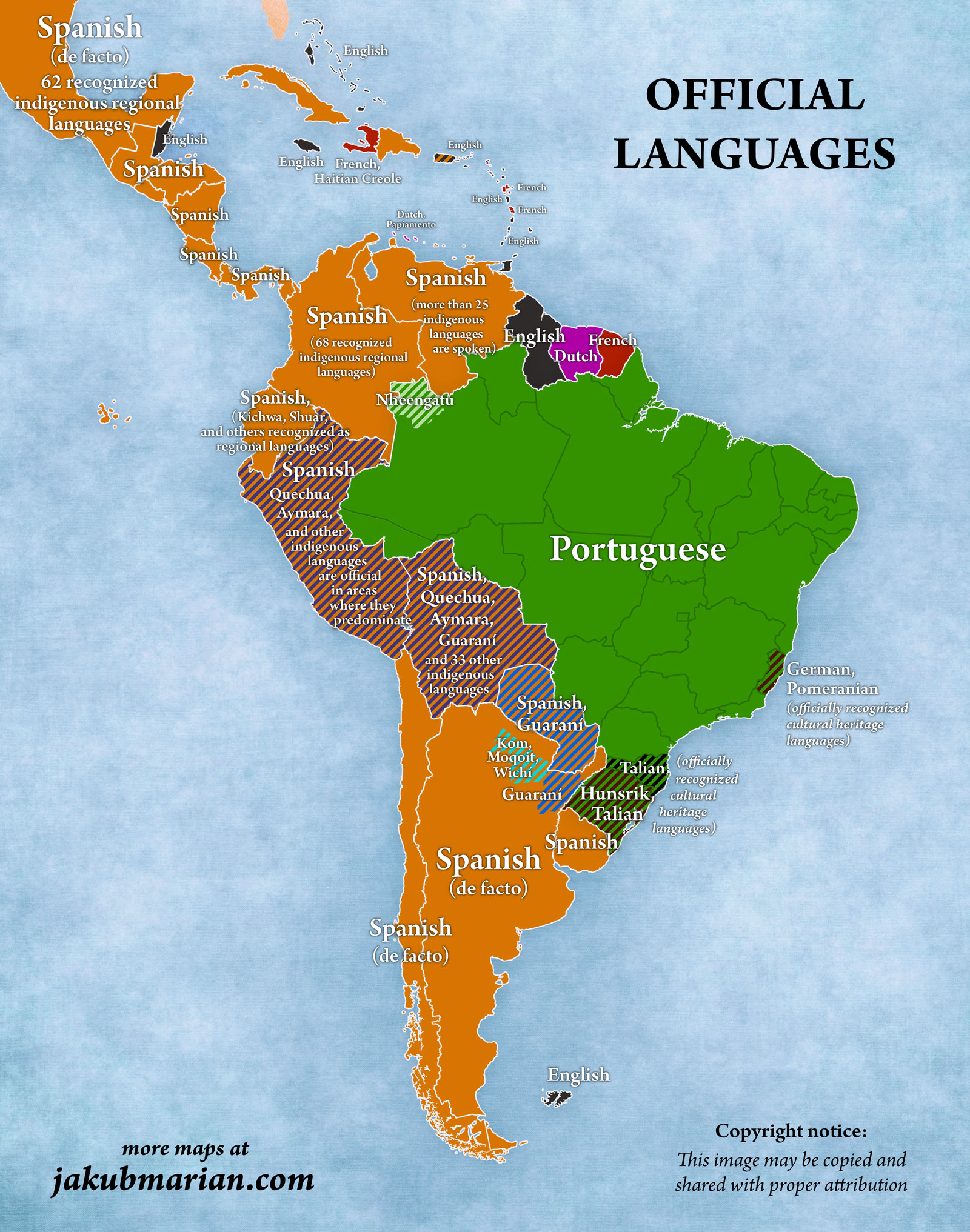
This map, created by the illustrator Jakub Marian in 2018, shows the official languages or languages with some form of protection in the different countries of South America and Central America.
As expected, the most widely spoken languages in the different countries and territories stand out, each marked with its own colour:
- Spanish, In orange: Argentina, Chile, Uruguay, Paraguay, Bolivia, Peru, Ecuador, Colombia, Venezuela, Panama, Costa Rica, Nicaragua, El Salvador, Honduras, Guatemala, Mexico, Cuba, the Dominican Republic, and Puerto Rico.
- Portuguese, in green: Brazil.
- English, in black: Guyana, Jamaica, Belize, Puerto Rico, Bahamas, Trinidad and Tobago, Puerto Rico, Barbados, and Saint Lucia
- French, in red: French Guiana, Haiti, Guadeloupe, and Martinique.
- Dutch, in pink: Suriname, Curaçao, and Aruba.
In addition, in many countries, one or more indigenous languages also have co-official status, as is the case with Guaraní in Paraguay, or Quechua and Aymara in Bolivia and Peru. More curious is the case of the official recognition of Venetian Italian or Eastern Pomeranian in some municipalities in Brazil, as the language used by European migrants in the 19th and 20th centuries.
Sources


 Español
  English (UK)