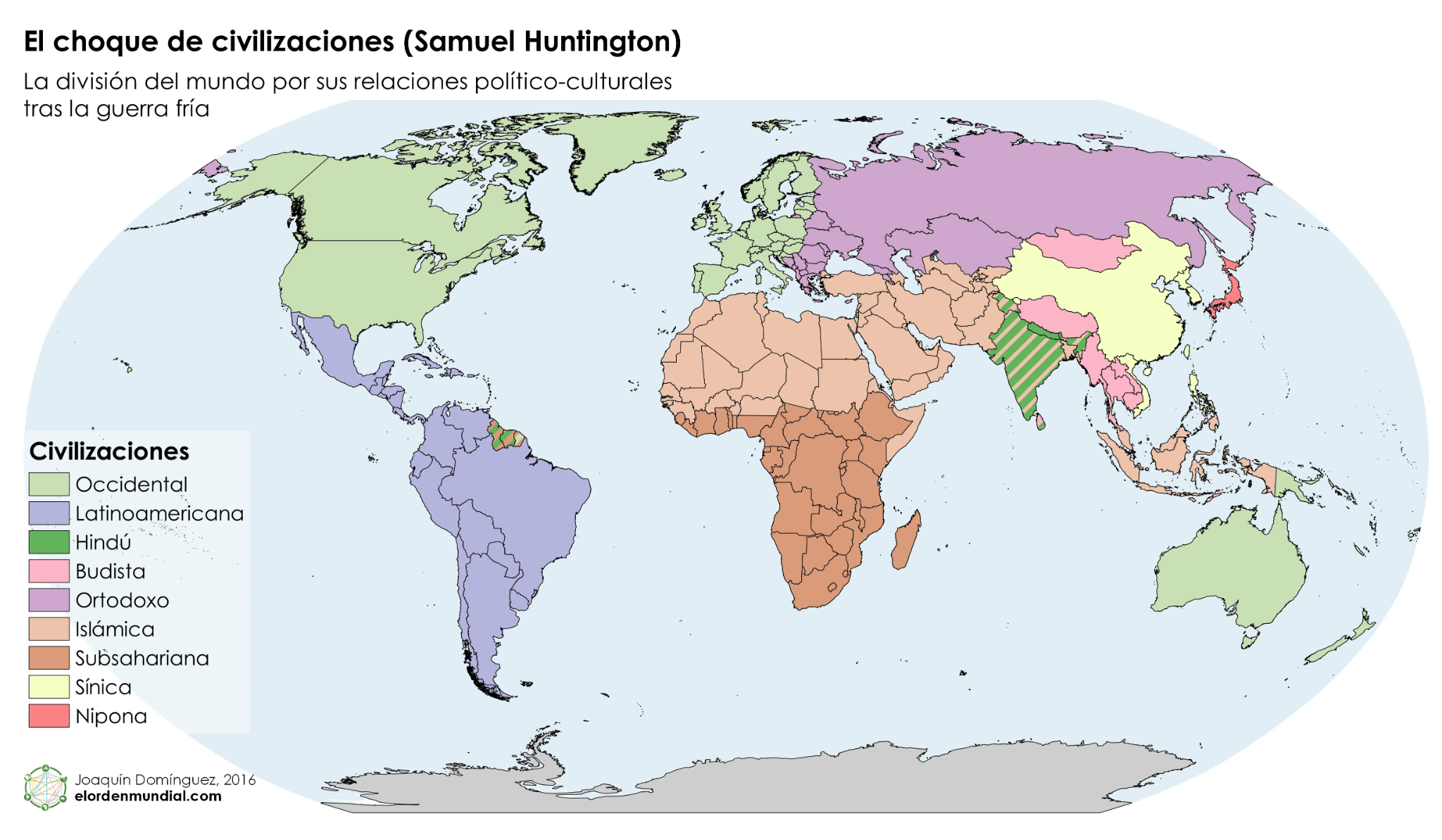
This map, created by Joaquín Domínguez for El Orden Mundial in 2016, shows the world divided into civilisations as established by Samuel Huntington in his 1996 book «The Clash of Civilisations».
According to Huntington, all conflicts after the end of the Cold War would have their origins in cultural differences between different groups. His theory was initially published in the journal Foreign Affairs in 1993 and later as a book in 1996.
The author initially established eight civilisations:
- Western: North America, Oceania, and Western Europe.
- Latin American.
- Hindu.
- Buddhist: Mongolia, Tibet, Myanmar, Thailand, Laos, and Cambodia.
- Orthodox: Russia, Eastern Europe and the Balkans.
- Islamic: North Africa, Somalia, the Middle East, Malaysia, and Indonesia.
- Sub-Saharan: Central and Southern Africa.
- Sinica: China, Korea, Vietnam, and northern Philippines.
Following criticism of his first edition, Huntington decided to separate Japan from Sinic civilisation in his second edition and form its own independent civilisation.
Huntington's approach gained much attention after the 11 September 2001 attacks on the Twin Towers, although it has often been strongly criticised in academic circles for its simplistic and biased view of the world. There is a certain consensus that the Clash of Civilisations thesis has not proven to be a reliable or useful guide to understanding the world after the end of the Cold War.
Sources


 Español
  English (UK)