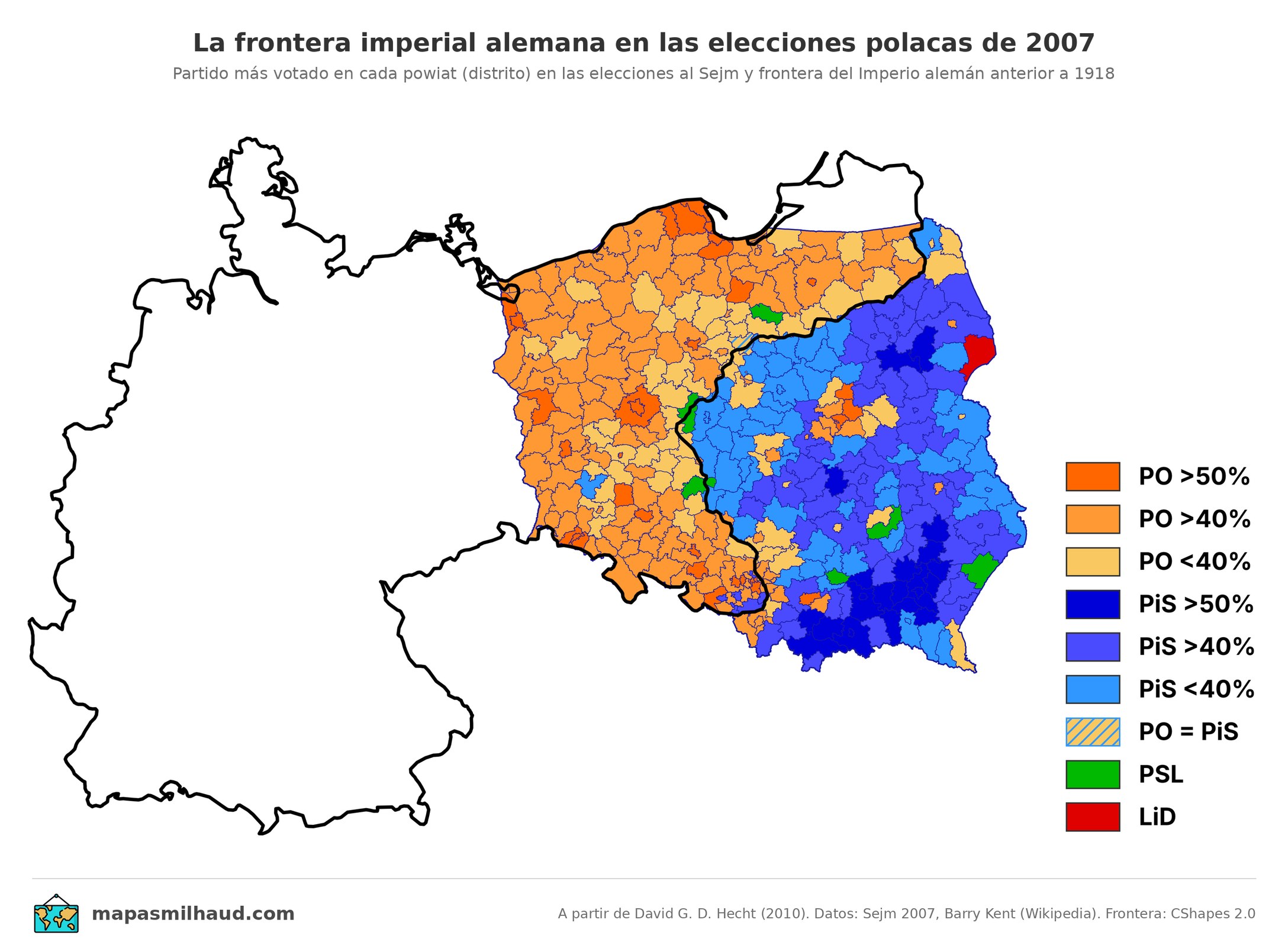
This map, created by David G. D. Hecht in 2010, superimposes the pre-First World War borders of the German Empire onto the results by powiat (district) of the 2007 Polish elections, taken from a map by Barry Kent on Wikipedia. It was shared by Frank Jacobs on Strange Maps, his column on Big Think. This version has been redrawn by Miguel García based on the current boundaries of the powiats, and the boundary is taken from the CShapes 2.0 database rather than the original hand-drawn outline.
On the map, orange represents the Civic Platform (PO), a liberal, pro-European centre-right party, and blue represents Law and Justice (PiS), a national-conservative party with a strong Catholic base. Each colour has three shades depending on the percentage of the vote obtained.
The former German imperial border, which ceased to exist in 1918, follows almost exactly the boundary between the two colours, from the Baltic Sea in the north to Silesia in the south. Hecht interpreted this as a long-standing cultural legacy, but much of the territory west of the line was German until 1945. Its population was expelled after the Second World War and replaced by Poles arriving from other regions, many of them from the eastern territories annexed by the Soviet Union. According to the political scientist Aleks Szczerbiak, the result was a society with fewer local roots and less religious practice.
Subsequent studies qualify this correlation. Irena Grosfeld and Ekaterina Zhuravskaya found no sudden shift in support for PO and PiS across the former German-Russian border, and attribute the divide to proximity to the West and to the northern ports. Where they did find it was on the border between Russia and Austrian Galicia, which does not appear on the map: on the Austrian side, religious observance is higher, and with it, support for PiS. The same divide has reappeared in subsequent elections, such as the 2020 presidential election and the 2023 general election.
Sources
- Polish Election Map Reveals Old Imperial Border
- Cultural versus economic legacies of empires: Evidence from the partition of Poland


 Español
 English (UK)