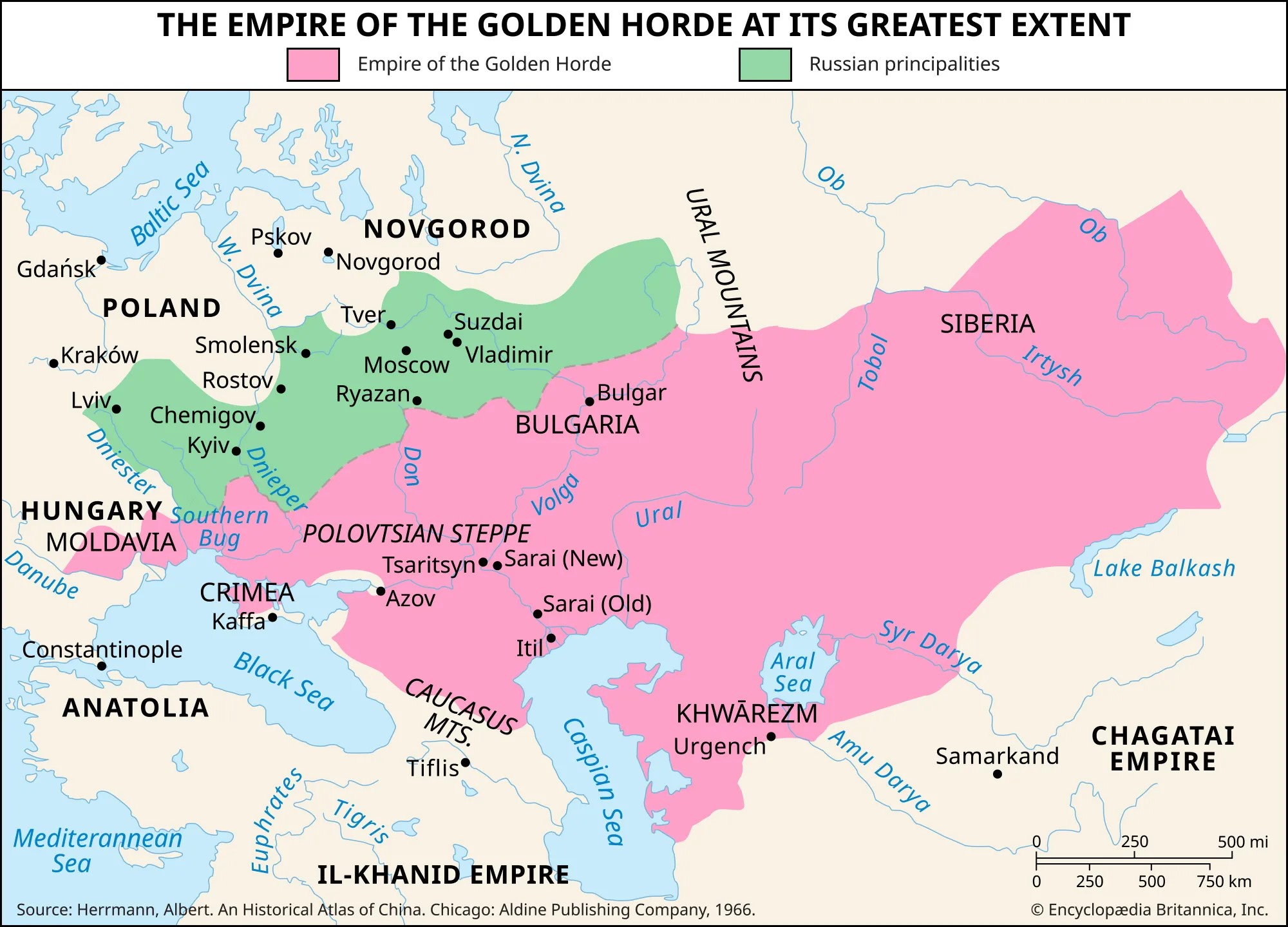
This map depicts the Golden Horde (in pink) at its peak, around 1310. The map originally appeared in the Historical Atlas of China (An Historical Atlas of China), published by Albert Herrmann in 1935. This particular version is taken from a 1966 reprint of the atlas, which has been recovered by the Encyclopaedia Britannica.
The Golden Horde was one of the Mongol states that formed after the death of Genghis Khan. It existed from 1242 to 1502, although its heyday was in the early 14th century. As can be seen on the map (in pink), it stretched from Siberia to the Danube, occupying Crimea, the northern part of the Caucasus, the area around the Aral Sea and the southern part of the great European Plain.
The map also shows, in green, the extent of the various Russian principalities that existed at that time, including Vladimir-Suzdal, Moscow and Galicia-Volhynia.
And yes, as the map shows, there was a Bulgaria in the heart of present-day Russia, commonly known as Volga Bulgaria.
Sources


 Español
  English (UK)