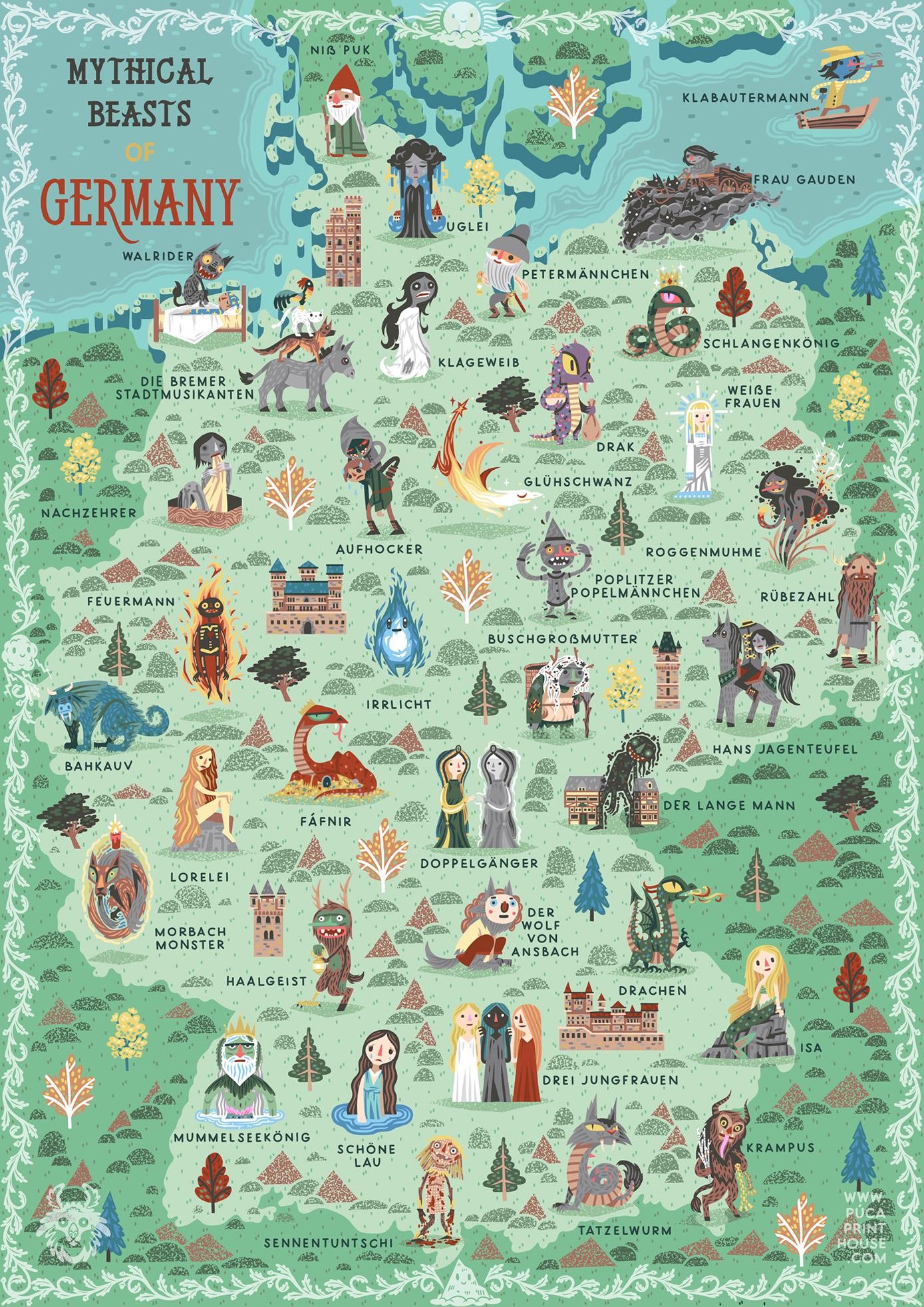
This map, created by Neil Parkinson of Púca Printhouse in 2024, shows monsters from German mythology.
Among the many myths that the author recovers in this map, some of the most iconic are worth highlighting:
- Aufhocker, the spirit that leaps onto the backs of night-time travellers and grows heavier and heavier as they walk on, until the victim collapses from exhaustion.
- The Wolf of Ansbach (the Ansbach wolf), the wolf that ravaged the area around Ansbach in the early 18th century and which, according to popular legend, was believed to be the spirit of the town’s recently deceased mayor, a man whom the people despised.
- Fáfnir, the dragon from Norse mythology who guards a treasure in the depths of the earth and whom the hero Siegfried slays in the Germanic sources of the Nibelungen cycle, in the Rhineland.
- Glühschwanz, the dragon-like spirit with a flaming tail that soared over the rooftops at night, illuminating the homes of the dishonest to expose their misdeeds and dropping thalers down the chimneys of the upright, in northern Germany.
- Lorelei, the female figure who, according to the legend popularised by Heinrich Heine in 1824, sits upon the rock of the same name on the banks of the Rhine, combing her golden hair, and whose hypnotic song lures sailors onto the rocks in the Middle Rhine.
- The Snow King (the king of Lake Mummelsee), the ruler of the waters of Lake Mummelsee in the Black Forest, whom tradition credits with the ability to control storms and the power to drag those who disturb his domain into the depths of the lake in the Black Forest.
- Nachzehrer, the dead man who, according to popular belief in northern Germany, continues to devour his relatives from the grave by gnawing at his own shroud, in the north.
- Roggenmuhme (the rye witch), the female spirit that lurks in the unharvested rye fields to snatch children who venture into them, linked to the agricultural traditions of north-eastern Germany.
- Rübezahl, the giant, ever-changing spirit of the Giant Mountains, on the border between historical Silesia and Bohemia, who controls the region’s weather and plays tricks on travellers, with a particular aversion to those who call him by his name in historical Silesia.
- Krampus, the demonic figure with horns and chains who accompanies St Nicholas in Alpine tradition and punishes children who have misbehaved during the year, in southern Bavaria and Austria.
Many of the myths depicted are typical of a much wider region than the one in which they are located on the map.
Sources
- Mythical Beasts of Germany
- Mythical Beasts of Germany [oc]
- Mythical Beasts of Germany: An illustrated map – A3


 Español
 English (UK)